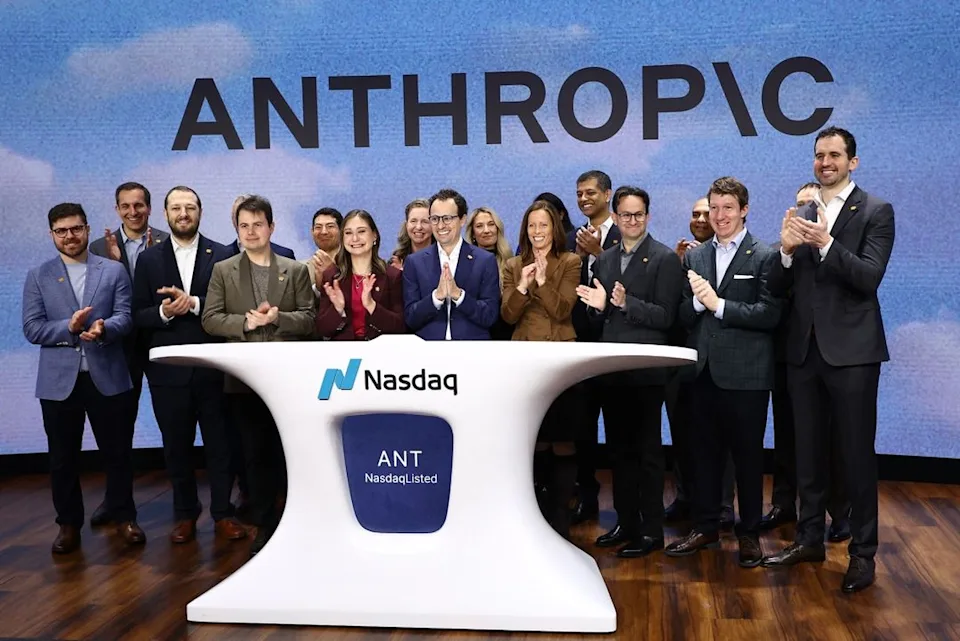
Why Wall Street Is Nervous: Anthropic’s record IPO captured headlines
Anthropic’s record IPO captured headlines, but a wider tech sell-off quickly tested investor confidence in AI. Here’s what the first week of trading reveals.
Anthropic’s debut on the Nasdaq was meant to be a milestone for the AI industry. Instead, it landed in the middle of one of the sharpest tech sell-offs in years. Together, the two events give a useful snapshot of where investor sentiment toward artificial intelligence stands right now.
A record-setting debut
The company priced its shares at $83, enough to value the business at $1.5 trillion and surpass SpaceX as the largest IPO on record. Demand was strong from the first trade: shares opened on the Nasdaq under the ticker ANT at $111.50, about 34% above the IPO price, in an offering that raised roughly $81 billion.
The enthusiasm had a financial basis. According to its prospectus, Anthropic reported about $33.2 billion in revenue over the first nine months of 2026.
But the opening price didn’t hold. Shares soared early on Thursday before giving back part of those gains in the afternoon, and the first day ended with the stock up 17% from its IPO price. One factor investors were watching was supply: the company’s SEC filing indicated that up to 315 million shares held by executives, directors, and current and former employees and consultants could become eligible for sale on day one.

A market already on edge
Anthropic didn’t list into a calm market. The broader tech sector had been under pressure for weeks. On November 5, the Nasdaq Composite fell 5.52%, its worst day in 19 months, and the Nasdaq 100 dropped 6.36%, its steepest one-day fall since the COVID crash of March 2020. That day the Composite closed 11.9% below its record, which put it in correction territory.
Then came Friday. Anthropic’s share price fell close to its offering price as markets tumbled, and company-specific news added to the weight. Nvidia’s shares plunged about 14% as US regulators were reported to be investigating its accounting practices.
The real question: what are AI valuations worth?
Beneath the daily moves is a bigger debate. Heavy tech spending on AI has fueled intense discussion about whether a bubble similar to the one before the 2000 dot-com crash is forming. Analysts cited by market commentators say investors increasingly feel AI company valuations have grown disproportionate to their underlying financials.
This is why Anthropic’s debut matters beyond one stock. It was the first major test of whether the public market will pay premium prices for a frontier AI developer. A strong first day showed appetite. A fast retreat toward the IPO price shows that appetite has limits when the surrounding market is shaky.
Not everyone sees disaster
Several observers argue a pullback isn’t necessarily bad news. In an AFP analysis, one expert suggested a slowdown could even be healthy by halting the most vulnerable projects. The same piece noted that the Nasdaq’s decline had wiped roughly $2.5 trillion from the market value of Nasdaq companies, a reminder of how much was priced in before the fall.
What to watch next
- Volatility from lock-ups and share supply. As more shares become tradable, price swings may continue.
- Earnings and cash flow. The market appears to be shifting from rewarding growth alone to demanding a clearer path to profit.
- Regulatory developments. Investigations like the one reported at Nvidia can shift sentiment across the whole sector.
- Spending discipline. Whether big tech’s AI investment plans hold steady or get trimmed will shape the next phase.
The bottom line
Anthropic’s IPO proved that investors still want exposure to AI. Its first week proved that they’re no longer willing to pay for it at any price. Whether this turns out to be a healthy reset or the start of something worse will depend on whether AI revenue can grow into the valuations now attached to it.
This article is for informational purposes only and is not financial advice. Figures are based on published reports as of November 21, 2026 and may change.